
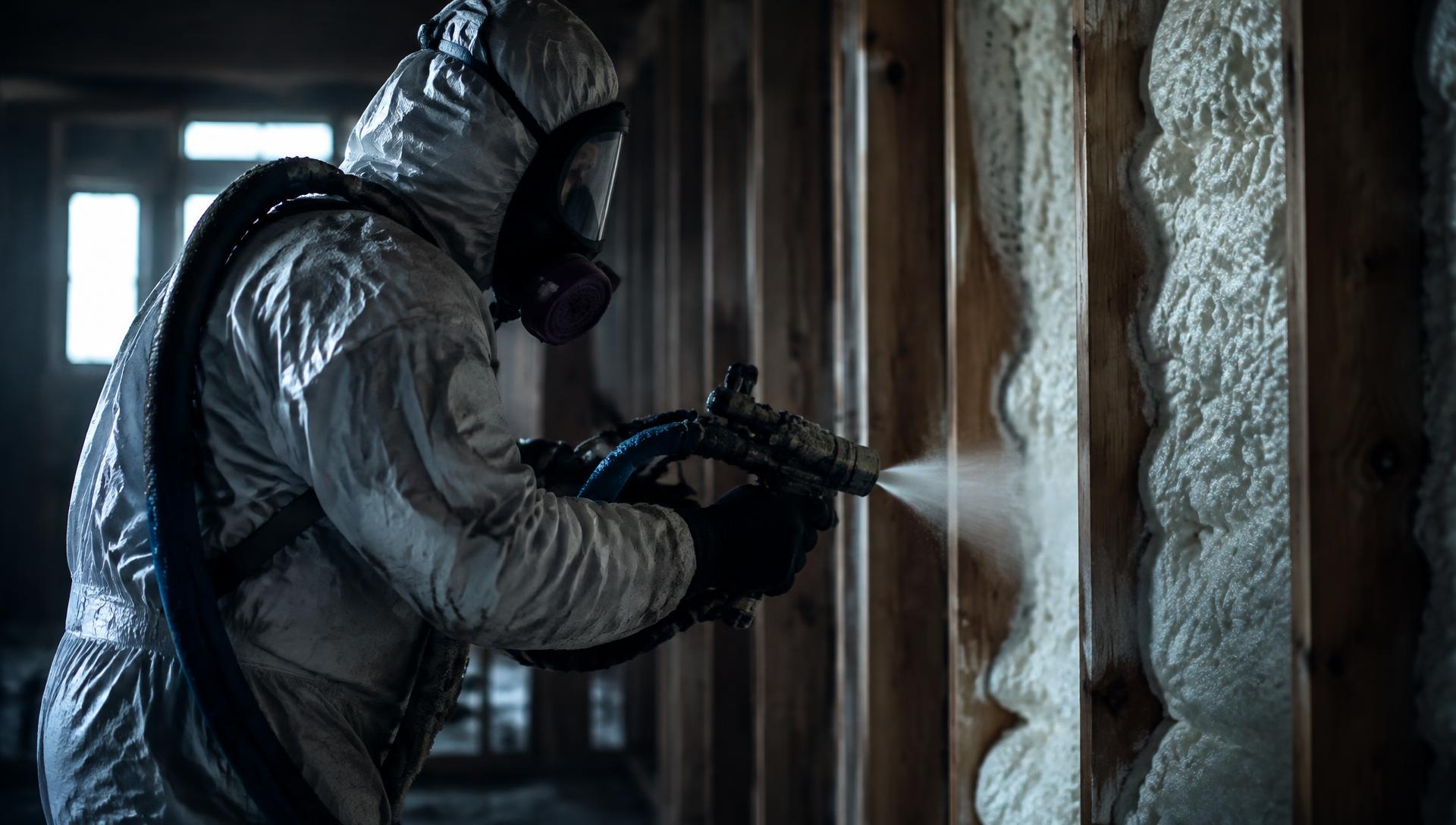
Spray foam insulation services
Closed-cell spray foam for homes, shops and commercial buildings.
Explore where spray foam goes
Select any part of the house.
Tap an area of the house or use the buttons above. Move your cursor to tilt the model.
Attic Spray Foam Insulation
Professionally designed attic insulation systems can help reduce unwanted heat transfer and air leakage, depending on the home's construction.
- Potential benefit
- Can help with upstairs comfort and air leaks through the ceiling plane.
- Foam often considered
- Closed-cell, depending on attic design
Final recommendations depend on an on-site assessment.
Why closed-cell foam
Open-Cell Spray Foam
Open-cell spray polyurethane foam is a soft, flexible, lower-density insulation whose cells are mostly open. It expands greatly on application, filling cavities and sealing air leaks, but it is vapor-permeable and can absorb water.
Closed-Cell Spray Foam
Closed-cell spray polyurethane foam (SPF) is a dense, rigid insulation whose cells are almost entirely enclosed. It insulates, air seals and resists moisture in one application, and can add rigidity to the building assembly.
| Property | Open-cell | Closed-cell |
|---|---|---|
| Material structure | Cells are open and interconnected; cured foam is soft and spongy | Cells are closed and tightly packed; cured foam is hard and rigid |
| Density | Typically about 0.5 lb/ft³; density varies by product | Typically about 1.75–2 lb/ft³; density varies by product |
| R-value per inch | Typically R-3.5 to R-3.8 per inch; use the specific product's published R-value | Typically R-6 to R-7 per inch; use the specific product's published R-value |
| Air sealing | Acts as an air barrier at sufficient thickness (often around 3+ inches) with continuous coverage | Acts as an air barrier at relatively thin applications (often around 1 inch) with continuous coverage |
| Vapor control | Vapor-permeable; does not act as a vapor retarder | Can qualify as a Class II vapor retarder at sufficient thickness (often around 1.5+ inches) |
| Moisture | Can absorb and hold water; not suitable where bulk moisture or damp conditions are expected | Resists water absorption; not a substitute for proper drainage or waterproofing |
| Rigidity | Soft and flexible; adds no structural rigidity | Dense and rigid; can add racking strength to the assembly |
| Typical locations | Interior applications such as sound control and some above-grade cavities in suitable climates | Attics, rooflines, exterior walls, basements, rim joists, crawl spaces, garages and metal buildings |
Why we install closed-cell in the Capital Region
Albany and the Capital Region have long, cold winters with real freeze-thaw cycles, plus damp basements, crawl spaces and rim joists. Open-cell foam is vapor-permeable and can absorb moisture, so in our climate it carries a higher risk of condensation and moisture problems in rooflines, walls and below-grade areas. Closed-cell foam's higher R-value per inch, vapor resistance and moisture resistance make it the safer, better-performing choice here — which is why it's the only foam we install.
Product, thickness and required protective barriers are chosen using the product's technical data, the building assembly, local climate and code. Values are typical published ranges, not a guarantee of performance.
Get a free estimateReady to make your property more comfortable?
Book a free consultation. We'll look at your property, answer your questions and give you a clear written estimate.